
When Experience Design Meets Organizational Reality
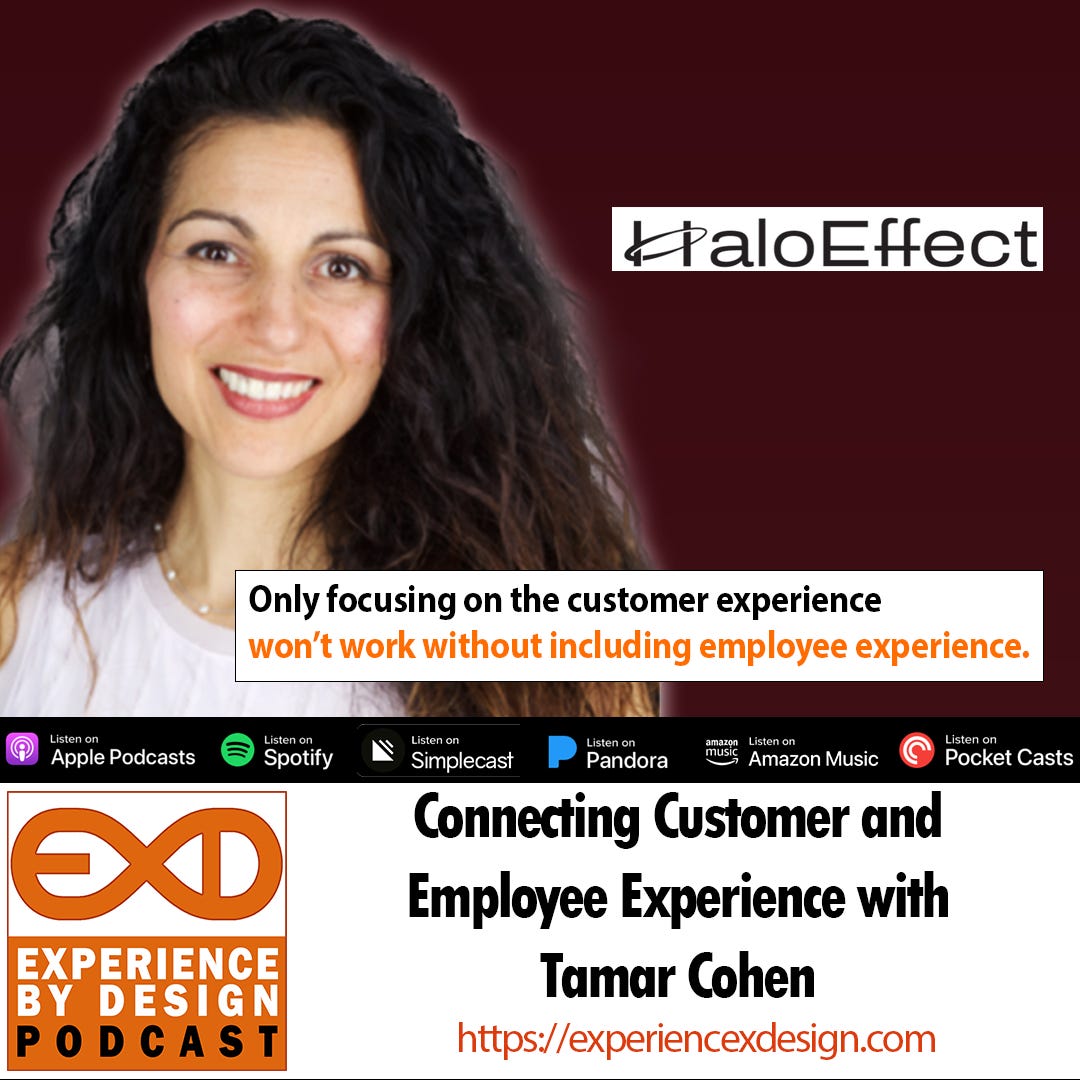
Connecting Customer and Employee Experience with Tamar Cohen

As I continue working on my upcoming book, The UN-WOW, I’ve been having conversations with professionals across experience design and experience management to test and refine the core ideas behind the project. Two themes have consistently surfaced.
First, people are overwhelmingly supportive of the book’s central premise: there is tremendous value in paying attention to the ordinary, everyday moments that shape our lives. Rather than focusing exclusively on extraordinary experiences, many see untapped opportunities in designing for the mundane. The enthusiasm and encouragement have been incredibly validating, and it has been exciting to hear how much interest there is in exploring these ideas further.
Second, many people point out that, at its core, experience design should not be all that complicated. The goal is straightforward: make life better for the people we serve. Whether we’re designing for customers, employees, patients, students, clients, or users, the mission remains the same. We are trying to create better experiences for human beings.
The complexity begins when organizational priorities compete with that mission. Companies often become consumed by metrics, efficiencies, and profitability in ways that can undermine human-centered goals. Experience professionals regularly encounter barriers that limit or prevent meaningful improvements. Many organizations talk about putting people first, but fewer consistently act on that commitment.
This Week’s Guest: Tamar Cohen
To explore these challenges and opportunities, I welcomed Tamar Cohen to the Experience by Design studio.
Like many leaders in the experience space, Tamar’s career path has been anything but linear. After studying Art History, she began her career working in galleries and auction houses before embarking on a 16-year journey at Citibank, where she applied the observational and analytical skills she developed through art to customer experience work.
Her career later expanded into leadership roles, including:
Head of Global Customer Experience Strategy at Zoetis
Vice President of Employee Experience at Travelers
Throughout the conversation, Tamar shares how these diverse experiences shaped her approach to designing better outcomes for both customers and employees.
Why Employee Experience Comes First
One of the central themes of our discussion is the powerful connection between employee experience and customer experience.
Tamar argues that organizations should think of their employees as their first customers. When employees are supported, empowered, and engaged, they are far better positioned to create meaningful customer experiences.
We also discuss the role of ethnographic research in understanding the complete employee and customer journey. By observing and listening deeply, organizations can uncover the unmet needs, frustrations, and opportunities that often remain hidden in traditional metrics and surveys.
The Halo Effect: Putting People First
Tamar also introduces her newest venture, HaloEffect, developed alongside Michael Lowenstein, and discusses additional work with James Killian, both familiar voices to longtime Experience by Design listeners.
At the heart of HaloEffect is what Tamar calls the Four E’s Framework:
Educate
Empower
Engage
Energize
Through qualitative research and organizational diagnostics, HaloEffect helps leaders understand the human systems within their organizations before attempting to solve business challenges. The approach is based on a deceptively simple principle: put people first.
While the idea sounds straightforward, execution is often where companies struggle. Tamar’s work focuses on helping organizations bridge that gap between intention and action.
Key Takeaways
In this episode, you’ll hear:
✅ Why employee experience and customer experience are inseparable
✅ How ethnographic research reveals deeper human needs
✅ What leaders can do to build genuinely people-first organizations
✅ The Four E’s Framework and the Halo Effect approach
✅ How an Art History background can lead to powerful insights in experience design
It was a thoughtful and engaging conversation that reinforces a lesson many of us in experience design already know: creating better experiences starts with understanding and valuing people.
Connect with Tamar
LinkedIn: https://www.linkedin.com/in/tamarcohen
HaloEffect: https://www.myhaloeffect.com/
Listen to the full episode of Experience by Design wherever you get your podcasts.
Good essay, Gary ... looking forward to reading your book. Or pre-reading it, if that helps. Making the 'mundane' a focus is brilliant!! After all, we are all humans and much of our lives are spent in the 'mundane-o-sphere'. I don't need an over-the-top experience when I put gas in the van, but I surely don't want the pump to burp and get gas on me. We at PurposeFully Human also talk about the real-life lived experiences of human, we should connect sometime, and maybe have you on our show, the PurposeFully Human Radio Hour.