
What is Diversity All About
Finding Shared Definitions for Cooperative Work

YouTube Video on What is Diversity
If you have been paying attention to the news, which it is not something I necessarily recommend, you would have noticed the number of stories concerning diversity, equity, and inclusion programs. You also will have noticed that not all of the stories are positive, with many politicians launching attacks against these programs.
The state of Florida, for instance, has been passing laws prohibiting the teaching of diversity in schools, as well as removing funding from schools’ diversity programs.
And they are not the only ones. Many states have chimed in, prohibiting the teaching and discussion of diversity. This map shows the extent to which different states are passing or trying to pass laws limiting the discussions of diversity-related topics in schools.
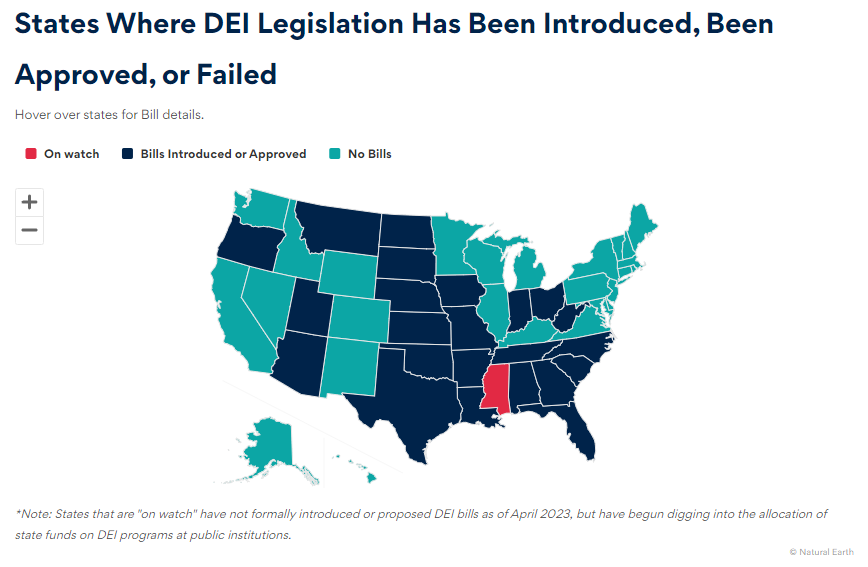
There even are attempts to punish businesses who are in favor of diversity efforts, and have programs to support diversity. It needs to be emphasized that these are private businesses who are operating in ways that they see are beneficial to their business and culture. There is even descriptions of diversity programs being “corporate-sanctioned racism. So much for less government regulation and the laissez-faire capitalism.
Given attempts by certain state governments to protect its citizens from diversity programs, diversity must be pretty awful. And harmful as well.
Absent from many of these discussions is what actually is diversity? How is it being defined in such a way that elicits such strong responses from government officials and legislators?
A basic definition of diversity is having representation of people from a variety of different backgrounds, social groups, and life experiences. To embrace diversity is to embrace the idea that having different kinds of people around is a good thing.
Seems pretty innocuous if this is what diversity means. After all, isn’t ‘diversity the spice of life?’ Isn’t trying new things, and having exposure to a range of experiences a way to keep life interesting?
So what is the big deal? Why are so many people raising issues with embracing the value of diversity? And what is the impact of this negative portrayal of diversity?
Michael Bush, CEO of Great Place to Work, writes in Fortune magazine that “The word ‘diversity’ is being hijacked and weaponized” to mean discrimination against some for the betterment of others. Diversity has become a rallying cry to create an “us versus them” mentality, rather than a “we” mentality.
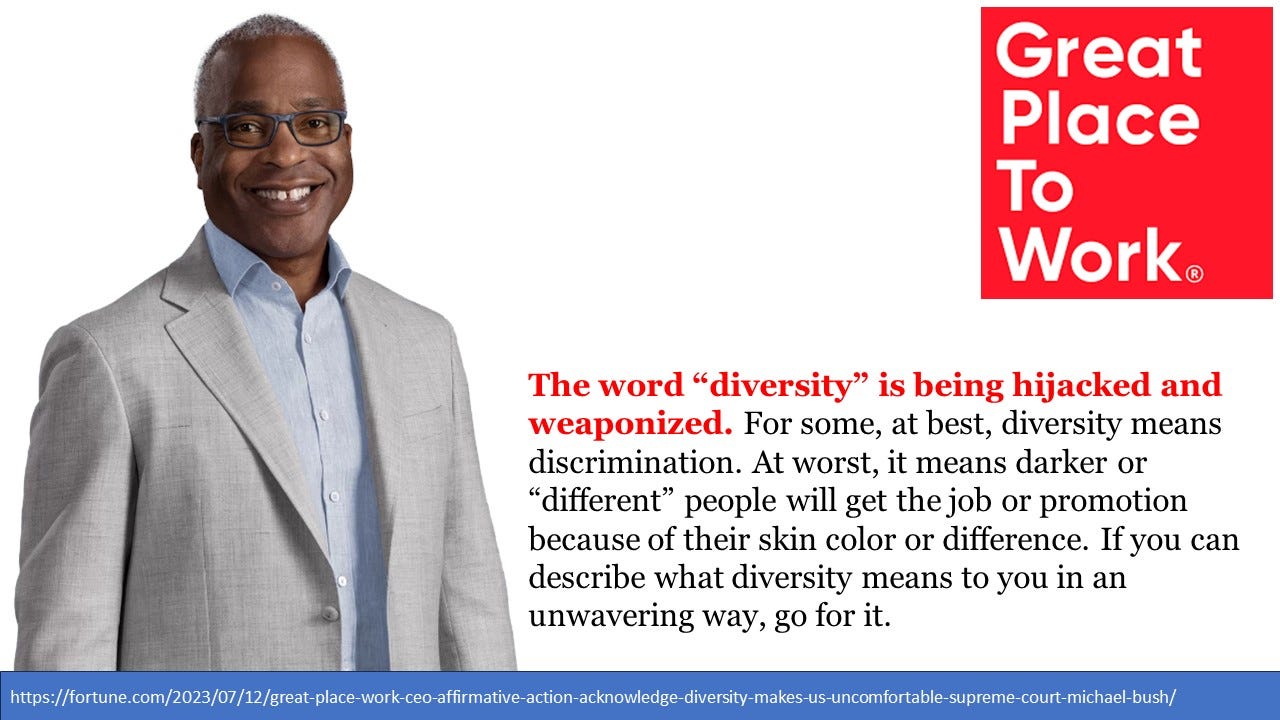
And too often when one of “them” get an opportunity, it is seen as taking an opportunity from “us.”
There are many reasons to care about and support diversity. We care about diversity because having diverse influences is vital for social progress, creativity and innovation, arts and culture evolution, and other positive outcomes. And more importantly, these outcomes can benefit “we”, and not just “us” or “them.”
If you take a look at human civilization, advances have come from locations through which people of different backgrounds came into contact. We can say the same for advancements in organizations as well. Diversity is an opportunity for growth and development. For enrichment and evolution.
When I am teaching classes regarding diversity, as well as doing DEI trainings for organizations, if anyone is cautious or hostile to the idea of diversity, I just ask them if they are in favor of everyone being the same. Is to be against diversity to be in favor of homogeneity?
The response to this question is typically, “Of course not.” People generally speaking see value in diversity, diversification, and having representation from different people, groups, and voices. So then, what is the deeper issue?
Asking this basic question allows us to explore what is it about how they understand “diversity” that turns them against it. And this allow us to continue the conversation in a more productive way by forging a dialogue around what diversity means.
To further discussion of diversity in organizations, Michael Bush adds the following recommendations:
If the word diversity is uncomfortable for you to use because you know it provides comfort to some and fear within others, I would acknowledge to your people why it makes you uncomfortable. Then state what you believe in, including how different beliefs, experiences, skills, and personalities are needed to drive innovation.
As a sociologist who studies language, I know that the meanings of words are a combination of their historical meaning and contemporary social construction. When definitions and meaning wildly diverge, it is incredibly hard to have a shared understanding and even more difficult to work together around it.
Thus, to further discussions on the importance of diversity, start by helping others understand the basic definition of diversity, how it also includes them, the positive outcomes of embracing diversity, and how those outcomes help everyone involved.
Not sure how to start and have these conversations? Reach out to me and let’s chat about how you can turn these moments into opportunities for growth.