
Putting Service First
Wedding Websites, Biases, and Giving of Ourselves

Video Version:
The US Supreme Court recently handed down a decision in the case 303 Creative LLC v. Elenis, in which the owner of a web design company claimed that the state of Colorado’s Anti-Discrimination Act, prohibiting businesses from discriminating against people of various social characteristics, violated her First Amendment rights of free speech.
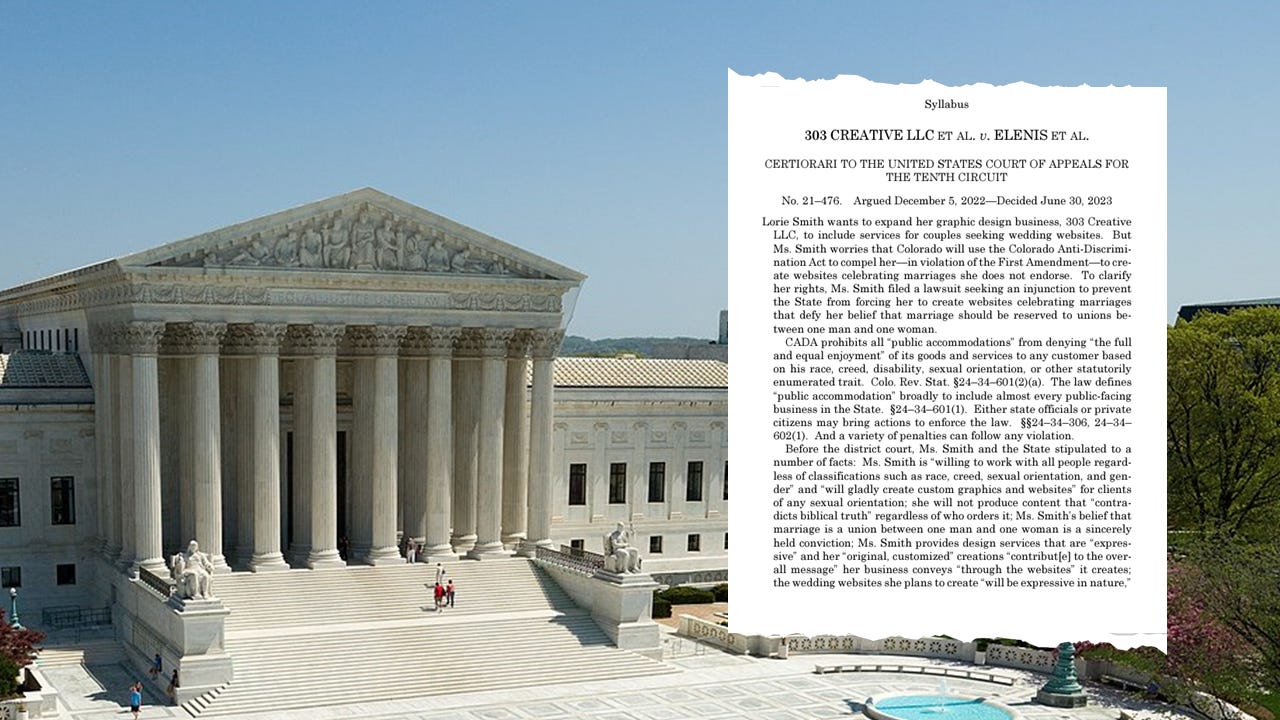
Apparently she felt the anti-discrimination laws were prohibiting her Constitutional right to…..I guess discriminate against same-sex couples seeking wedding website design.
Similar to the Masterpiece Cakeshop, Ltd. v. Colorado Civil Rights Commission 2018 case, Lorie Smith, the owner of 303 Creative LLC, said that it was against her religion to participate in any celebration of same-sex marriage.
Therefore, she should not be compelled to provide website services to same-sex couples.
It is important to keep in mind that the state of Colorado sought no action against Lorie Smith. In fact, Smith had not yet even started to provide wedding site services through her company. While her claim did cite a same-sex couple did request a wedding site, an article by The New Republic revealed that actually no one had asked her to make them a wedding site. The couple in the claim it would seem were fictitious.
Thus, unlike the Masterpiece Cakeshop case, 303 Creative was suing against an idea of providing services, and not in response to actual people seeking.
It would seem that even the potential of having to provide services to a same-sex couple was enough to cause the owner grievous concern. And in a 6 to 3 decision, the court ruled that the possibility of her not being able to discriminate based on her stated religious beliefs was a violation of her rights, specifically her free speech rights as an artist.
In the dissent, Justice Sotomayor penned,
Today, the Court, for the first time in its history, grants a business open to the public a constitutional right to refuse to serve members of a protected class. Specifically, the Court holds that the First Amendment exempts a website-design company from a state law that prohibits the company from denying wedding websites to same-sex couples if the company chooses to sell those websites to the public. The Court also holds that the company has a right to post notice that says, ‘no [wedding websites] will be sold if they will be used for gay marriages’.
The dissent concludes that the Supreme Court is once again in its history legalizing discrimination.
Lunch counters and Seeking Service
Of course, this is not the first time that personal belief has been expressed through denials of customer service.
We can go not too far back in US history and see the efforts to integrate lunch counters and other spaces of services, where Black customers were not allowed. Denials of service are always part of discrimination.
The Jim Crow South was predicated on the Supreme Court idea of “separate but equal” brought by the Plessy v. Ferguson case of 1896. It wasn’t until the Civil Rights Act of 1964 that legal segregation ended, although the practice would continue in many ways.
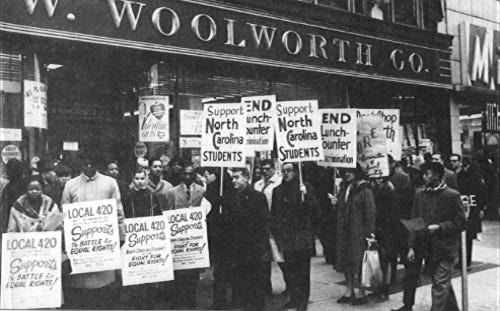
This just shows that while the law may change, social norms often take longer to catch up. And sometimes, unfortunately, laws change back to allow the thing we thought time had erased.
In July 2020, I was part of a panel brought together by the Customer Experience Professional Association chapters of Boston and Atlanta. In his panel, we discussed customer experience and the Civil Right struggle, using CX to promote racial equity, addressing bias in customer experiences, and how to capture customer voices around issues of race in service.
Also, for a while now I have been collecting instances where customers allege the denial of service because of their skin color. I presented some of this material in a presentation at the American Sociological Association, where I discussed “The customer is always right, unless they’re black.”
Such cases have not abated, and might be increasing. You can find many examples of where people feel that they have gotten reduced service, or no service, because of the biased attitudes of those who were responsible for serving them.
It would then appear that the sentiment of “your kind is not welcome here” is still alive and well.
What does It Mean to Serve
Ironically perhaps, all of this is being discussed while we are living in the midst of the ‘service economy, where the number of service jobs and companies outpaces those of manufacturing and industrial production.
We might be living in the service economy, but what does service actually mean?
The origins of the word can be traced as far back as 1100AD. The world also is linked to the Latin servus, which means slave. This meaning would morph into an act of serving, to being a servant, condition of servitude, and of course service.
In all of the ways that the word service evolved, there always is a sense of intimacy and immediate connection in it. Service is about connection, no matter how momentary or fleeing. We come into contact with one another, one looking for something and the other being able to help. One is beholden to another to provide something, render aid, to give of oneself in order to assist another.
Service in Recovery Work
When we commit acts of service, in many ways we are doing something with others in mind. And in the process, we lessen our own attention on ourselves. It is for this reason that service is a foundational part of recovery programs.
There is a saying in Alcoholic Anonymous that “you can only keep what you have by giving it away.” This means that sobriety is only sustainable by helping others who are working toward their own sobriety.
12-step programs in general operate through the efforts of their members. Whether making coffee, hosting a meeting, welcoming newcomers, sharing their own story, sponsoring someone, or other means, these efforts extend the program to others and help each member live their recovery.
Another important aspect of service is that it takes the person out of themselves, removing the focus on the individual and putting it on the work of helping others. Doing so helps to build one’s self-confidence and sense of self-worth.
Regarding this point, there is a lovely quote from the website Amethystrecovery.org that goes as follows:
Every act that we perform has an effect on those around us, which in turn affects the balance of everything we know. The balance of our very lives is determined by the quality of our actions. This is not to say that we should embrace character defects such as pride or self-centeredness; in fact, we should do the very opposite. To recognize the importance of our actions toward others is not to inflate our own egos, but rather to accept that we do not outrank anyone else. And the ultimate demonstration of the humility that accompanies such a valuable realization is the performance of service work.
To provide service is to be humble before another, and to do so willingly because that act of humility further strengthens us.
The Bear Forks Episode and service
There are themes of recovery and service all throughout the hit Hulu series the The Bear. These themes intersect in Episode 7 of Season 2, aptly called Forks. In this episode, one of the main characters Ritchie is assigned to polish forks at what is seen as the best restaurant in the world. It is a task that he initially sees as beneath him.
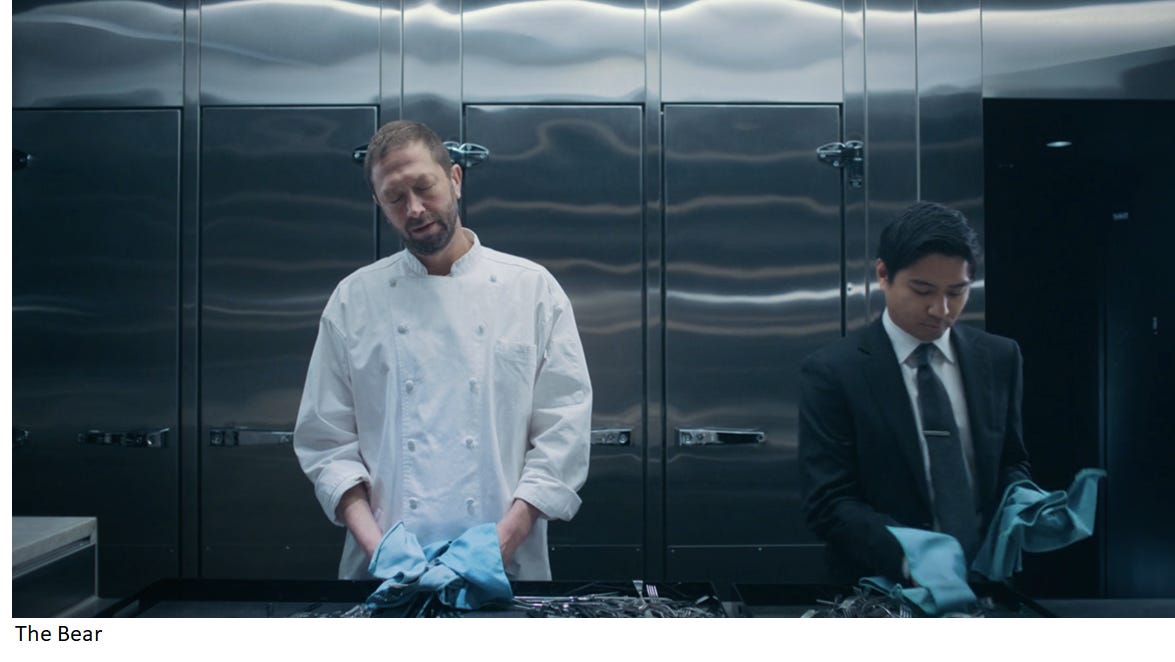
When Ritchie asks his supervisor why he does this type of work in a restaurant, his supervisor responds that he is an alcoholic and went through many rough years. He was finally able to stop drinking through recovery programs.
He continues that a key tenet of recovery is service. In service he found himself, which brought him to make his job in the restaurant an extension of his recovery.
So much of this episode is about serving others. All of the little details and going out of your way to please customers becomes the foundation of every scene. Going above and beyond because it will make people happy and create a more memorable experience. The food is the vehicle for everything else that happens around it.
And everything else happens not because people working there have to do it, but because they want to do it. By giving of themselves, they are simultaneously making themselves more whole.
Summary
So where does all this put us in relation to the Supreme Court case as well as customer experience.
There can be a lot of motivations for opening and/or working a business. Ideally one of them would be to provide a service that people. And it is not just to provide a service, but be in service to others, to give of oneself for the aid of others, to be a servant to others to make their lives better.
To deny service is in many respects to deny that the customer has a status that should be honored. It is to refuse putting one in the position of a servant to the needs of others. Ultimately it is to violate the entire notion of the idea of service economy.
Where this movement ends is hard to say. One positive outcome to emerge from the 303 Creative case is that the owner has publicly stated her biases, to which the internet has responded. From Yelp comments saying “Do not support this business,” “I am ashamed of who you represent” and “we are back in the 60s and Jim Crow,” to “At least the entire world now knows that this business discriminates and should never be used.”
Perhaps business should be regulated to state out front who they will not serve and then let the market decide who they would like to support.
Ultimately, what makes a multicultural society function is the embracing of higher ideals such as service which puts us into relationships, no matter how temporary, that we might not enter into in our personal lives.
Commerce can create connection, but not if we reduce our worlds through our biases. As well as putting service first.